
 English
more 

 English
 Views: 0 Author: Site Editor Publish Time: 2026-08-21 Origin: Site


For label converters and printing companies, choosing the right synthetic paper is not only about waterproof performance or durability. The material must also perform consistently during printing, die-cutting, and high-speed converting.
Compared with traditional wood-pulp paper labels, synthetic paper materials such as PP synthetic paper and PET synthetic paper provide excellent resistance to water, tearing, chemicals, and outdoor conditions. These advantages make them widely used in food packaging, cosmetics, logistics, industrial labels, and durable identification applications.
However, synthetic substrates have different converting characteristics from traditional paper materials. Without proper material selection, converters may encounter production problems such as incomplete cutting, adhesive bleeding, poor waste stripping, and unstable production efficiency.
Understanding the relationship between synthetic paper properties, adhesive compatibility, and die-cutting performance is essential for achieving reliable label production.
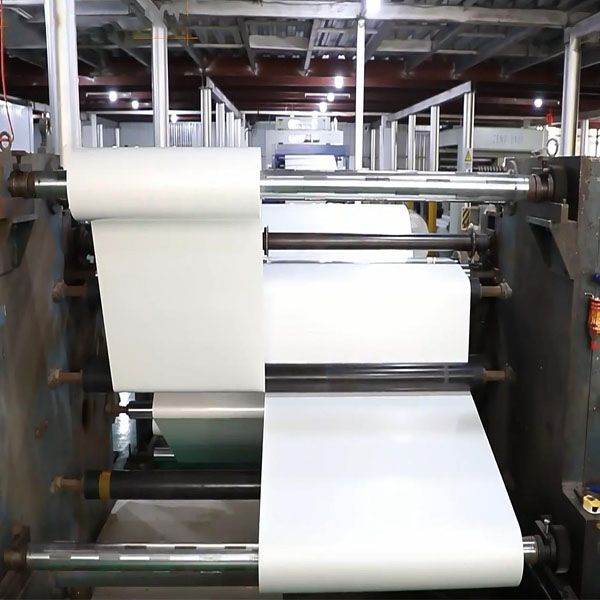
Not all synthetic papers behave the same during label converting. The polymer structure directly affects printing performance, flexibility, and die-cutting results.

PP (Polypropylene) synthetic paper is one of the most commonly used materials for waterproof labels.
Its main advantages include:
Excellent flexibility
Good moisture resistance
Lightweight structure
Smooth printing surface
Strong resistance to tearing
Because PP has higher flexibility compared with PET, it is suitable for applications requiring bending resistance or soft-touch characteristics.
Typical applications include:
Food and beverage labels
Cosmetic packaging labels
Logistics labels
Promotional stickers
During die-cutting, PP requires stable pressure control because excessive force may cause material deformation or adhesive squeeze-out.
PET (Polyester) synthetic paper provides higher stiffness and dimensional stability.
Key advantages include:
Excellent tensile strength
Better temperature resistance
Higher rigidity
Superior long-term durability
PET synthetic paper is often selected for demanding applications such as:
Industrial identification labels
Chemical labels
Outdoor labels
Long-life product markings
Compared with PP, PET generally provides cleaner cutting edges, but requires suitable tooling conditions to avoid edge cracking or unnecessary blade wear.
Synthetic paper offers excellent durability, but its non-fibrous structure creates different converting challenges compared with traditional paper.
For label manufacturers, the most common issues include:
A common problem during synthetic label production is incomplete separation between the label and liner.
Possible causes include:
Incorrect die pressure settings
Uneven material thickness
Cutting blade wear
Material mismatch with tooling
A high-quality synthetic paper substrate with consistent thickness helps maintain stable cutting pressure across the entire roll.
Because synthetic paper surfaces are non-absorbent, adhesive behavior is especially important.
If the pressure settings or adhesive system are not properly matched, converters may experience:
Adhesive overflow at label edges
Sticky cutting blades
Difficult waste removal
Reduced production speed
For high-speed converting, synthetic paper should be matched with suitable pressure-sensitive adhesives and release liners to ensure smooth processing.
Waste matrix removal is a critical step in label production.
Poor matrix stripping may occur due to:
Excessive web tension
Material stretching
Weak liner performance
Incorrect die-cutting depth
Stable synthetic paper construction helps maintain consistent waste removal and reduces production interruptions.
For label converters, material consistency is just as important as the final product performance.
Even advanced printing and die-cutting equipment cannot fully compensate for unstable raw materials.
The key factors include:
Consistent thickness ensures:
Stable die-cutting pressure
Better production efficiency
Lower material waste
Thickness variation across a jumbo roll can lead to uneven cutting results and additional machine adjustments.

Synthetic paper requires specialized surface treatment to achieve reliable printing results.
A well-designed coating system improves:
Ink adhesion
Flexographic printing performance
UV printing compatibility
Scratch resistance
For converters, the ideal synthetic paper should provide both excellent printability and reliable converting performance.
The best material choice depends on the final application, printing method, and converting requirements.
Application | Recommended Material | Key Benefits |
|---|---|---|
PP Synthetic Paper | Waterproof, flexible, economical | |
Cosmetic Labels | PP / PET Synthetic Paper | Premium appearance, chemical resistance |
Industrial Labels | PET Synthetic Paper | High durability and stability |
Outdoor Labels | PET Synthetic Paper | Weather resistance and long service life |
PP Synthetic Paper | Lightweight and tear resistant |
Before selecting a synthetic substrate, converters should evaluate:
Printing process
Label size and shape
Die-cutting speed
Adhesive requirements
Environmental conditions


At LIZHENG, we understand that synthetic paper is not only a printing material — it is a key factor affecting the efficiency of the entire converting process.
Our PP and PET synthetic paper solutions are developed for professional label applications, providing:
Consistent thickness and surface quality help converters achieve reliable printing and die-cutting results.
Special surface treatments support different printing technologies, including flexographic, offset, and UV printing.
We provide:
Jumbo rolls for industrial converting
Customized thickness options
Different sizes according to customer requirements
Technical support for application selection
With stable material quality and manufacturing experience, LIZHENG helps label converters reduce production issues and improve overall efficiency.
Successful synthetic label production requires more than simply replacing traditional paper with a waterproof material.
The substrate must be carefully selected according to:
Printing requirements
Die-cutting conditions
Adhesive compatibility
Final application environment
By choosing a reliable synthetic paper supplier, label converters can reduce waste, improve production stability, and deliver higher-quality labels to their customers.
Contact LIZHENG for product specifications, samples, and technical recommendations.
Email: lizhengpaper@gmail.com


